
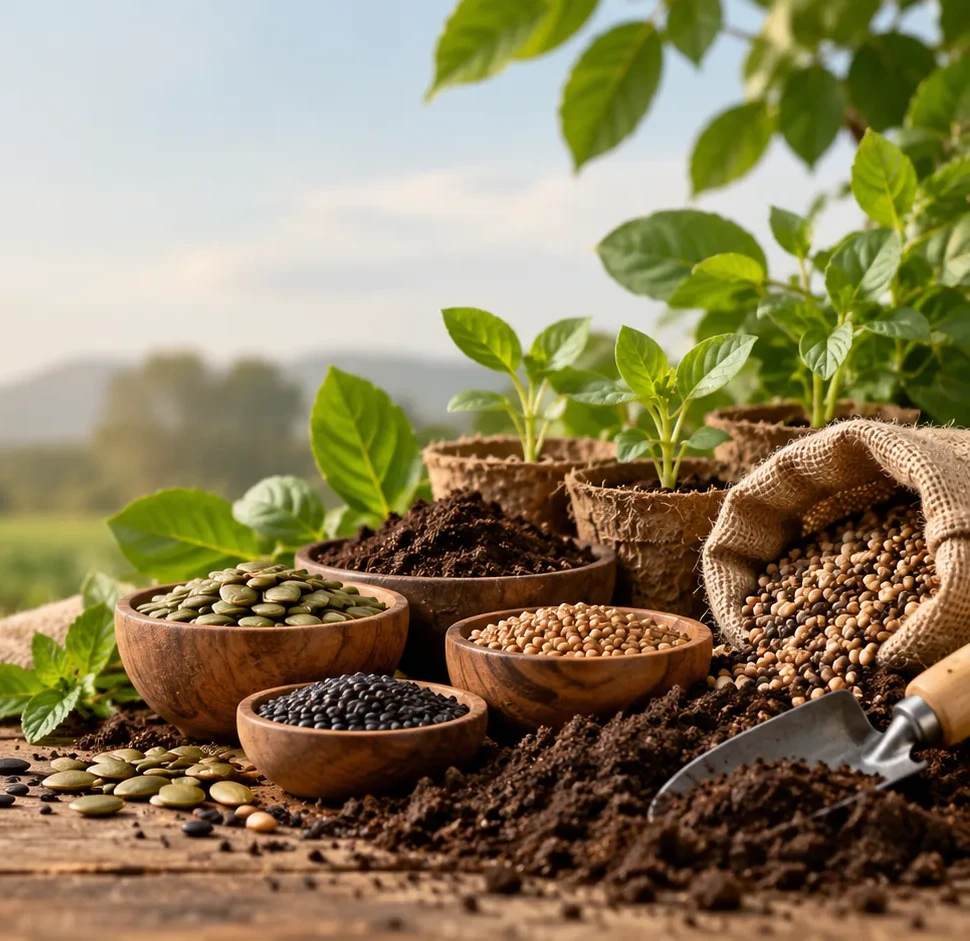
Description
Jeevamrit is the first thing most natural farmers learn to make. It is a fermented liquid that carries beneficial microbes from cow dung and farm soil back into your field, where they help break down organic matter and keep the soil alive. It is traditionally applied with irrigation water or as a light foliar spray.
We don’t sell Jeevamrit — and we’d rather you didn’t buy it from anyone. It works best fresh, and every ingredient is already on or near your farm. Prepare it yourself at almost no cost. If you want to see it made and ask questions in person, request a farm visit.
Ingredients (for 1 acre)
| Water (non-chlorinated) | 200 litres |
| Fresh desi cow dung | 10 kg |
| Desi cow urine | 5–10 litres |
| Jaggery (dark/old) | 1–2 kg |
| Pulse flour (besan or any pulse) | 1–2 kg |
| Live soil from your farm bund or under a big tree | 1 handful |
How to prepare
- Pour the water into a 200-litre drum kept in the shade.
- Add the dung and urine and mix well.
- Dissolve the jaggery and pulse flour in a little water and add to the drum.
- Add the handful of soil — this is your starter culture.
- Cover loosely with a jute sack. Stir clockwise for about two minutes, twice a day.
- It is ready in 2–4 days (sooner in warm weather) when it smells mildly fermented, not foul.
How to use
- With irrigation: 200 litres per acre, flowed in with irrigation water, about twice a month.
- As a foliar spray: filter through cloth and dilute — about 5 litres in 100 litres of water for young crops, rising to 10–20 litres in 200 litres as the crop grows.
- For trees: pour 2–5 litres around the drip line (not at the trunk), on moist soil.
Storage & shelf life
Use within about 7 days of preparation. Keep in the shade and keep stirring. Don’t seal the drum airtight.
Good practice
- Apply on moist soil, ideally in the evening, and keep a mulch layer so the microbes have food and shade.
- Use desi cow inputs where you can; that is the traditional recommendation.
- Try it on a small patch first and watch how your crop responds.
Shared as traditional natural-farming knowledge (as taught in Subhash Palekar Natural Farming / APCNF programmes). Results vary with soil, climate, crop and preparation. This is not a registered fertiliser and no specific yield outcome is promised.

Reviews
There are no reviews yet.